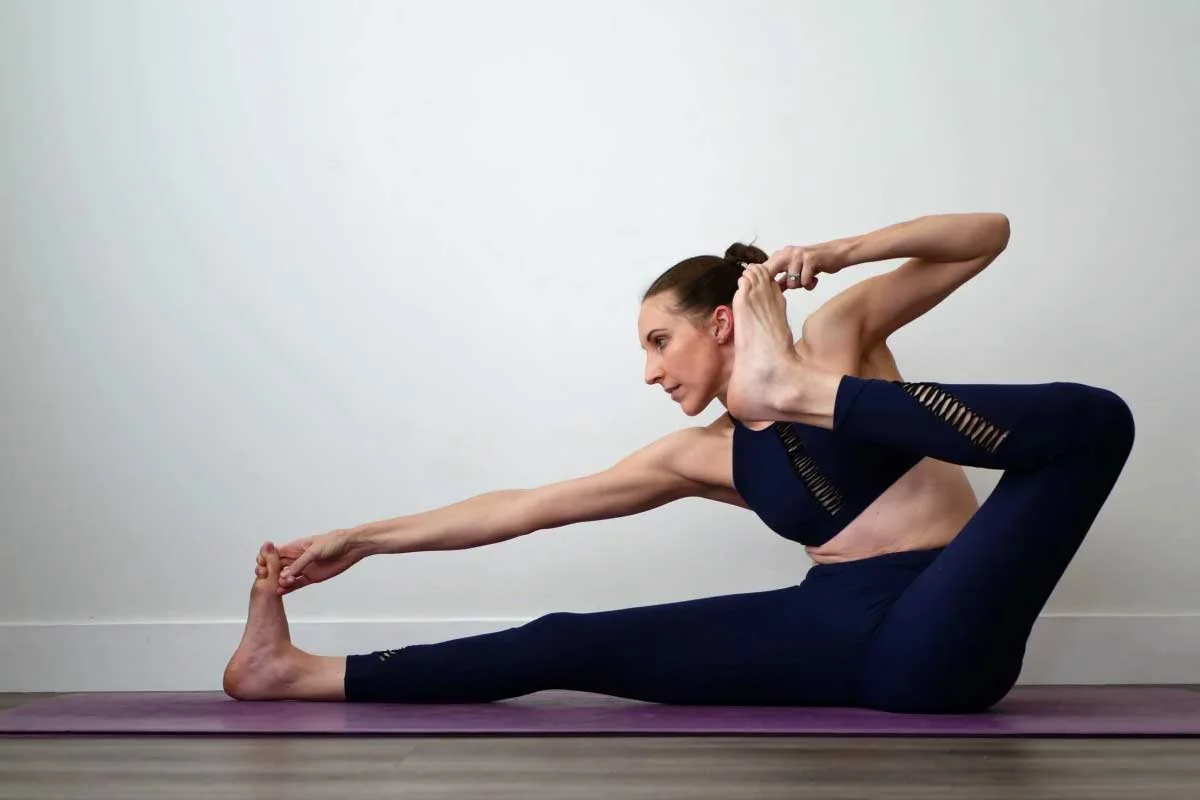
In classical Sanskrit, A-karna means "toward the ear" and Dhanur signifies "bow." Akarna Dhanurasana (Archer's Pose) is an iconic classical posture described in the Hatha Yoga Pradipika and Gheranda Samhita. The yogi mimics an archer drawing an arrow to their cheek, balancing intense hip socket external rotation with laser-sharp mental concentration (Dharana).
Hip Socket Mobility
Learn how to lubricate the femoral head in the acetabulum safely without twisting or straining the knee joint.
Laser Drishti Focus
Harness single-pointed visual and mental concentration by anchoring your gaze past the extended front big toe.
Strap Modifications
Master progressive modifications using yoga straps for practitioners whose hamstrings limit seated reach.
Key Physiological & Energetic Benefits
Unlike modern gymnastic stretches, classical Archer's Pose integrates deep muscular engagement with visceral organ compression:
- Unlocks the Hip Joint Capsule: Safely increases external rotation and flexion in the femoral head, building the foundation needed for Padmasana (Lotus Pose).
- Stimulates Lower Abdominal Organs: As the thigh compresses firmly against the rib cage, it massages the ascending/descending colon, relieving sluggish digestion and chronic constipation.
- Strengthens Scapular Stabilizers & Latissimus: Drawing the elbow high and back actively recruits the rhomboids, middle trapezius, and posterior deltoids.
- Cultivates Ekagrata (Single-Pointed Focus): Directs prana upward into Ajna Chakra (Third Eye) by maintaining a steady, unbroken gaze (Drishti).
Information Gain: Akarna Dhanurasana vs. Other Hip Openers
| Posture | Primary Hip Action | Spine Orientation | Mental / Drishti Anchor |
|---|---|---|---|
| Akarna Dhanurasana (Archer) | Deep external rotation & flexion | Vertical, axial elongation | Front extended big toe (Padayoragra) |
| Dhanurasana (Prone Bow) | Extension & adduction | Thoracic & lumbar extension (Backbend) | Third eye or tip of nose (Nasagra) |
| Janu Sirsasana (Head-to-Knee) | Passive external rotation & abduction | Forward flexion & axial rotation | Forward shin or foot |
Step-by-Step Execution & Alignment Cues
- Base Position (Dandasana): Sit tall on your mat with both legs extended straight ahead. Press the sitting bones down, flex the feet, and lengthen the spine upward.
- Yogic Toe Lock: Lean forward from your hip crease. Loop the index and middle fingers of both hands around the corresponding big toes, sealing the grip with your thumbs. Keep the spine long.
- The Draw: Inhale deeply. Bend your right knee, sliding the right foot along the mat. Keep the left leg rooted firmly to the floor.
- Lift Toward the Ear: Exhale and pull the right foot up toward your right ear, pointing the right elbow high and backward, exactly like an archer drawing a bowstring. Keep the right knee pointing toward the armpit.
- Lock the Drishti: Steady your gaze over the extended left big toe. Do not allow your lower back to collapse backward; maintain an erect spine.
- Hold & Release: Breathe smoothly for 5 to 8 slow breaths. On an exhalation, lower the right leg back to Dandasana, rest for two breaths, and repeat on the opposite side.
Crucial Alignment Safety: Protect the Knee
Never wrench the foot toward the ear if you feel sharp pain or torque inside the knee joint. The rotation must originate from the hip socket, not the delicate knee ligaments. If your hamstrings or hips are tight, loop a yoga strap around the foot and hold the strap with an upright spine.
Advance Your Asana & Philosophy at Great Bali Yoga
Learn classical postures with correct biomechanical alignment, hands-on adjustments, and sacred roots. Explore our 200-Hour Yoga TTC in Bali or peaceful Wellness Retreats in Ubud.
View Dates & Fees